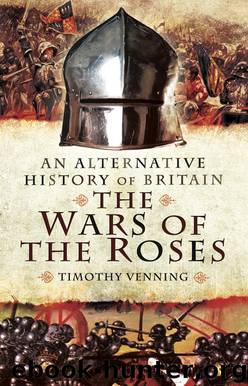
The War of the Roses by Timothy Venning
Author:Timothy Venning
Language: eng
Format: epub
ISBN: 9781783468959
Publisher: Pen and Sword
Published: 2013-08-19T04:00:00+00:00
Richard of Gloucester and a more adult Edward V: a king at odds with his uncle like Richard II’s and Henry VI’s uncles?
If Edward IV, apparently in poor health and not campaigning in person by 1482, had died when his elder son was aged over fifteen or so (c. 1486) there would have been no need of a ‘Protector’. A semi-adult Edward V would have succeeded with the Woodvilles as the main power at court. Richard would then have been isolated and unable to secure influence with the King, but with his military power in the north would have been too powerful to be dealt with decisively except by a trick. The messy expense and defeat of his attempts to take over Scotland for a client king could have provided his enemies with an opportunity to undermine him. Like the previous Dukes of Gloucester, Thomas and Humphrey, he would have been vulnerable to a sudden arrest and execution by a distrustful nephew encouraged by his rivals. He would have been very much aware of their fates, and of the fact that they had both been seized by surprise by a ‘treacherous’ King–Thomas arrested in person by a royal-led ‘posse’ at his Essex residence of Pleshy Castle, and Humphrey arrested at Parliament at Bury St Edmunds.
Richard’s alternative course was to put himself at the head of a coalition of disaffected lords complaining at a monopoly of patronage by the Queen’s kin, in the manner of Simon de Montfort against the Poitevins in the 1250s or Thomas of Lancaster against Gaveston and other royal allies in 1308–22. The chances are that Richard would not have challenged them in his brother’s lifetime, unless Edward IV was seriously ill or ‘senile’ and perceived to be the helpless puppet of a greedy clique as Edward III had been in 1376. Both ambitious nobles such as the Duke of Buckingham (Richard III’s real-life chief assistant and then betrayer in 1483) and a ‘reforming’ Parliament impatient at the abuse of power, as in 1376, could have aided Richard’s ambitions to overturn the power of the King’s current favourites as Edward IV aged and lost control of politics and patronage through the 1490s.
The dynamics of inter-state relations would have been the same, with England balanced against France and the Empire. Would Edward V or Richard, Duke of York been married off to Catherine of Aragon or a sister of hers–not the oldest, Juana, as heiress to Castile–as part of an alliance with Ferdinand and Isabella against the old enemy, France? (There were no French princesses near their age available.) The sister of Philip I of Burgundy and daughter of Emperor Maximilian, Margaret (born 1480), was an alternative and would have been useful in an anti-French alliance; Edward IV’s sister Margaret (real-life Yorkist pretender-sponsor from 1486 to 1499) was available to negotiate with her stepson-in-law Maximilian. It is possible that the French regency-government would have retaliated for Edward IV’s support for Breton independence from 1488 by smuggling Henry Tudor
Download
This site does not store any files on its server. We only index and link to content provided by other sites. Please contact the content providers to delete copyright contents if any and email us, we'll remove relevant links or contents immediately.
In Control (The City Series) by Crystal Serowka(36276)
The Wolf Sea (The Oathsworn Series, Book 2) by Low Robert(35308)
We Ride Upon Sticks by Quan Barry(34609)
Crowbone (The Oathsworn Series, Book 5) by Low Robert(33684)
The Book of Dreams (Saxon Series) by Severin Tim(33444)
The Daughters of Foxcote Manor by Eve Chase(23694)
Trainspotting by Irvine Welsh(21833)
Call Me by Your Name by André Aciman(20602)
The Secret History by Donna Tartt(19296)
Shot Through The Heart (Supernature Book 1) by Edwin James(18975)
All the Missing Girls by Megan Miranda(16316)
American King (New Camelot #3) by Sierra Simone(16217)
The Girl from the Opera House by Nancy Carson(15833)
Pimp by Iceberg Slim(14666)
Sad Girls by Lang Leav(14540)
The Betrayed by David Hosp(12902)
The Betrayed by Graham Heather(12882)
4 3 2 1: A Novel by Paul Auster(12512)
Still Me by Jojo Moyes(11380)
